ChatGPT ads don't change the answer. That's the whole problem.





Last updated: September 25, 2026 · By Rose Samaras, founder of Reaudit.io
Short answer: We've tracked ChatGPT ads since they launched in the US. Across every client use case we've analysed, we haven't found one where we'd recommend spending on them. The ad sits below the answer and doesn't change it. In our own tests, 39% of the ads we captured had nothing to do with the question, and in food & beverage export 0% were relevant.
That's a strong statement from a company whose whole business is AI search. So let me show you why.
When we saw the first ad
OpenAI started showing ads to US users on the Free and Go tiers on February 9, 2026, and opened self-serve buying on May 5. We started tracking from the first week. Since then we've logged every sponsored card that shows up against the prompts we monitor for our clients.
The money is real
Nobody is questioning the audience. ChatGPT has around 900 million weekly users. OpenAI says its ads business hit a $1 billion annualised run rate in under 200 days, with tens of thousands of advertisers, and it's now opening up across Europe, India and the Middle East.
The demand from advertisers is there. The results are not.
The results aren't
Look at what advertisers are actually reporting:
Click-through rates sit under 1%. One advertiser saw 0.91% in ChatGPT against a 6.4% Google benchmark in the same sector.
One B2B campaign paid for 336 clicks. Those came from 146 companies, and only 5 of them matched the ideal customer profile.
One agency saw 57 clicks in OpenAI's dashboard and fewer than 20 visits in Google Analytics. They paused the campaign.
OpenAI itself tells advertisers there are no performance benchmarks yet.
A low CTR on its own doesn't mean the channel is bad. It's what's behind the low CTR that matters.
The ad doesn't change the answer
Think about how people use ChatGPT. They don't type three keywords. They write a paragraph: their situation, their budget, their constraints. ChatGPT gives them a full answer.
That answer is the product.
The ad appears afterwards, as a separate labelled block below the response. OpenAI promises the ad doesn't influence the answer. That's the right promise for user trust. But it also means the ad is structurally disconnected from what the user asked.
On Google, an ad competes for the click before the user finds what they need. In ChatGPT, the ad arrives after they already have it. It's a banner under a finished conversation.
That creates little value for the advertiser and even less for the user.
"But the ads only reach free users"
I hear this a lot, and it isn't the problem.
Free users are the vast majority of ChatGPT's audience, so that's where the attention is anyway. Paid tiers being ad-free doesn't hurt the channel much.
The problem is the format.
What our tests show
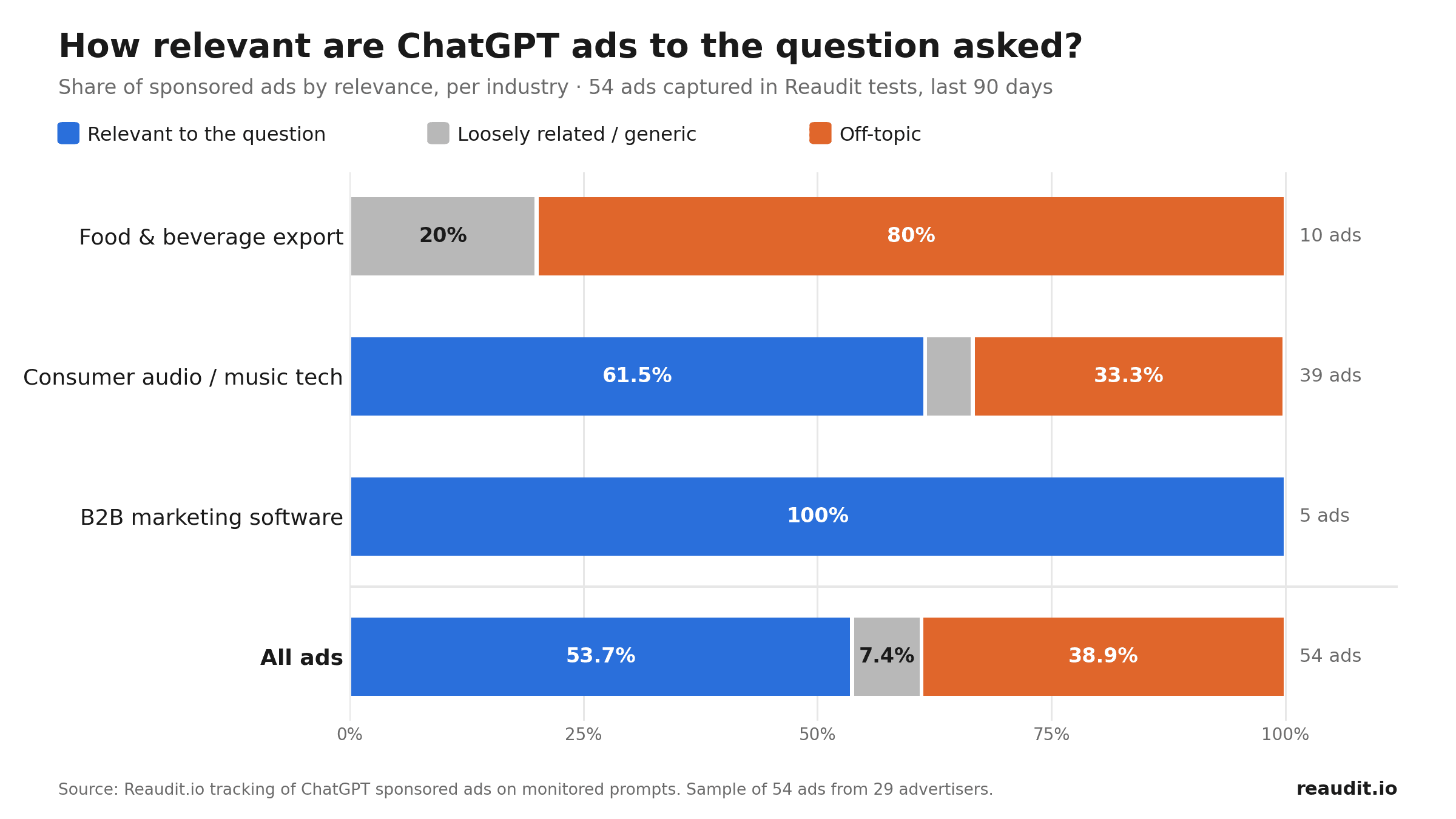
We captured 54 ChatGPT sponsored ads from 29 advertisers across the industries we track over the last 90 days. We classified every ad against the question it appeared under.
Industry | Ads captured | Relevant | Loosely related | Off-topic | Off-topic advertisers |
|---|---|---|---|---|---|
Food & beverage export | 10 | 0% | 20% | 80% | 7 of 9 |
Consumer audio / music tech | 39 | 61.5% | 5.1% | 33.3% | 9 of 15 |
B2B marketing software | 5 | 100% | 0% | 0% | 0 of 5 |
All ads | 54 | 53.7% | 7.4% | 38.9% | 16 of 29 |
How we classified them: Relevant means the ad matched the category the user asked about. Loosely related means generic supplies with no link to the product. Off-topic means no connection at all.
The pattern is clear: the more specialised the industry, the worse it gets.
In food & beverage export, a buyer asked how to source specialty food products for distribution abroad. The ads underneath were for warehouse management software, a Google Ads agency, an accounting firm, a general business marketplace and a product-data tool. Another buyer asked about export-ready packaging for food. They got an AI logo maker, a tape dispenser, plastic bags and a service to form a US company. That's 0 out of 10 ads relevant to food.
In consumer audio tech, 9 of the 15 advertisers had nothing to do with the category: app development agencies, industrial sensors, machine-vision cameras, IT managed services and a furniture rental company.
Two more things stood out. Even the relevant ads in food and audio came from big retailers, never from the brand's direct competitors. And only in B2B marketing software were the ads consistently on-topic. Even there, the ad didn't change the answer. It just sat underneath it.
We're not alone in this. Another agency analysed more than 50,000 prompts and found about 1 in 7 ads were unrelated to what the user asked. In niche categories, our numbers are much worse.
Note: this is a sample of 54 ads over 90 days from the prompts we track, so read it as "in our tests", not as a market-wide rate.
What comes next
We've been building a feature internally around what we believe comes next. A user sees an ad, opens a conversation with the brand's own AI agent in a new window, and gets their questions answered right there.
On September 16, OpenAI announced exactly that. It's called Sponsored Agents, and it's in limited alpha with a small group of US advertisers.
We expect it to roll out widely next year, and that's when ChatGPT ads start to make sense.
The reason is simple. In ChatGPT, the conversation is the product, so the ad has to become a conversation too. When a user can ask the brand "will this table fit my room?" and get a real answer, the ad finally does something the organic answer can't.
What to do until then
Unless you have budget you need to spend, don't spend it here. There's no strong case yet.
Put the money into being in the answer. The organic response is what users read and trust. If ChatGPT doesn't mention you, an ad below it won't fix that. Reaudit.io does exactly that, tracks your brand/product in every ai search engine, surfaces the gaps, the competition and helps you cover those gaps.
Get ready for agents now. When Sponsored Agents open up, your agent will only be as good as the information behind it. That means clean product data, pricing, FAQs and documentation. Start now, not when the format launches.
If you test anyway, verify everything. Use UTMs, compare OpenAI's numbers with your own analytics, and check who is actually clicking. Keep the budget small. You can also see who is buying ads on your prompts with ChatGPT competitor ad intelligence.
ChatGPT ads will matter. Just not in their current form.
P.S. In our tests, 39% of ChatGPT ads had nothing to do with the question. In food & beverage export, 0% were relevant. That tells you where the format is today.
FAQ
Do ChatGPT ads change what the model recommends?
No. Sponsored placements appear alongside the generated answer but do not modify the recommendation itself. The model's suggestions come from its training data, retrieval layer, and cited sources, not from the ad buy.
How does ChatGPT show ads to users?
Ads appear as separate sponsored elements within the chat interface, typically as chat cards or promoted content blocks. They are visually distinct from the answer text and do not replace it.
Does ChatGPT have advertisements in all markets?
Availability has expanded gradually since launch and varies by region and account type. Teams in EMEA should verify current availability for their target markets before planning spend.
What are the current ChatGPT ad formats?
Formats have centred on chat card placements and promoted content blocks. As the OpenAI ad platform matures, additional formats and ChatGPT ad targeting options are expected.
Can I buy my way into ChatGPT recommendations?
No. There is no paid mechanism to force a brand into the generated answer. Visibility is earned through content quality, entity signals, citations, and third-party authority.
What is AI share of voice and why does it matter?",
AI share of voice measures how often your brand appears in AI-generated answers relative to competitors across a defined prompt set. It is the closest equivalent to rankings for AI search and directly affects shortlist inclusion.
Should I pause SEO work to fund ChatGPT advertising?
No. SEO and AI visibility reinforce each other. Content that ranks and gets cited feeds the retrieval layer that AI assistants draw from. Cutting that investment to fund ads weakens the foundation.
How do I track whether ChatGPT mentions my brand?
Run structured prompt sets on a schedule and record mentions, sentiment, and citations. Manual checks are not scalable, so most teams use a dedicated AI visibility platforms like Reaudit to automate tracking across ChatGPT, Perplexity, Gemini, and Claude.
Are ChatGPT ads worth testing for e-commerce brands?
They can be worth a controlled test, particularly for offers with clear intent. But e-commerce brands should first ensure their product pages are retrievable and cited, since that drives the organic AI recommendations that convert.
What should EMEA teams do first?
Establish a baseline of AI visibility across priority markets and languages, identify where you are absent from high-intent prompts, and fix the content and citation gaps before allocating budget to paid placements.
Sources

About the Author
Triantafyllos Rose Samaras
Founder & CEO
Triantafyllos Rose Samaras is the founder and CEO of Reaudit, the pioneering AI Search Visibility Platform that helps businesses understand and optimize how they appear across AI search engines. Recognizing that 25% of online searches now happen through AI platforms like ChatGPT, Claude, and Perplexity, Triantafyllos identified a critical market gap: traditional SEO tools were completely blind to this new search paradigm. While companies invested millions in Google optimization, they had zero visibility into how AI systems perceived, cited, and recommended their brands. Reaudit was built to answer the question every modern business needs to ask: "How does AI see my brand?" Based in Greece, Triantafyllos is building a globally competitive AI company, proving that innovation can come from anywhere. He is passionate about helping businesses navigate the transition from traditional search to AI-powered discovery.