Bing AI Performance Report Explained: How to Use Grounding Queries and AI Citations to Optimize Your Visibility Across All AI Engines




Microsoft's AI Performance report (public preview launched February 10, 2026) reveals which of your pages Bing AI cites and which grounding queries trigger those citations. This gives you a concrete starting point for improving AI-search visibility.
Why the Bing AI Performance Report Matters Now
Traditional SEO has focused on keyword rankings and click-through rates. In 2026, a new metric is demanding attention: AI citation volume, meaning the number of times an AI-generated answer references a URL you control.
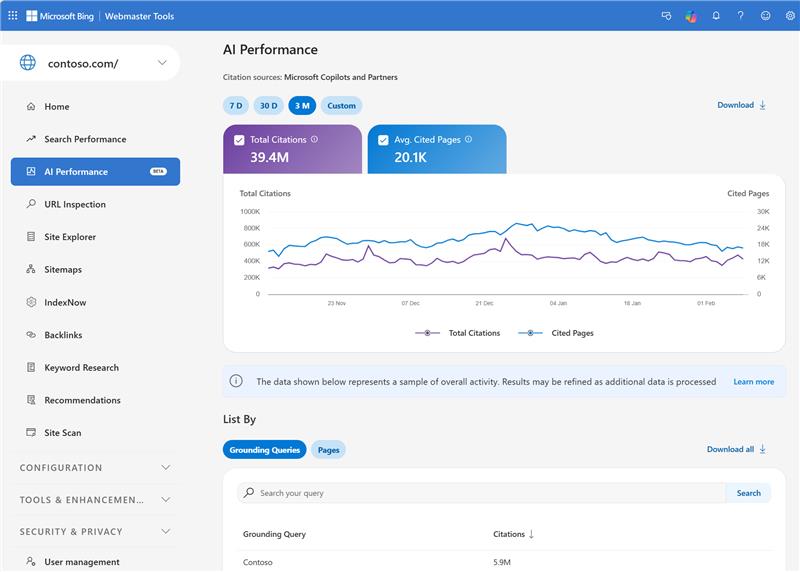
The Bing report surfaces five core data groups: total citations across Copilot and Bing AI summaries, average cited pages per query, grounding queries (the internal prompts Bing's retrieval engine uses), page level citation activity, and visibility trends over time.
Understanding these signals lets you treat grounding queries like keyword opportunities and align your content to the exact phrasing AI models use when retrieving information.
Grounding Queries vs. Traditional Search Queries
Grounding queries are not the phrases users type into the search box. They are the semantic "translation" the AI performs behind the scenes to match user intent with indexed content.
Here's an example: a user asks "How can I improve my Shopify store speed in 2026?" Bing's retrieval layer generates a grounding query like "Shopify speed optimization 2026" to locate relevant pages before composing the final answer.
The key differences matter. Grounding queries are used for content retrieval, not for ranking on a SERP. They often combine product, intent, and a time-sensitive modifier (like "2026" or "latest"). And a page cited for a grounding query appears directly in the AI answer, bypassing traditional ranking algorithms entirely.
How Bing Measures Grounding Query Performance
The AI Performance dashboard lists each unique grounding query, the number of citations it generated, and the URLs that were referenced. Microsoft has not published absolute benchmark numbers yet, but the report provides a sample-based view that you can track week by week to spot trends.
Interpreting the Core Metrics
Total Citations
The sum of all references to your domain across Copilot chat, Bing AI answer cards, and partner-generated summaries. A rise in total citations signals that more of your content is being treated as a trustworthy source.
Average Cited Pages
Total citations divided by the number of distinct pages that received at least one citation. A higher average suggests each page is being referenced multiple times, which indicates deep topical relevance.
Page-Level Citation Activity
This view shows which specific URLs earned citations for which grounding queries. Use it to identify your best-performing pages and spot content gaps where no citations appear.
Visibility Trends
The chart tracks citation volume over 30, 90, and 180-day periods. Seasonal spikes often line up with time-sensitive grounding queries (e.g., "2026 SEO tools").
Actionable Playbook: From Data to Optimization
1. Export Grounding Queries Weekly
Download the CSV from the dashboard every Monday. Treat the list as a keyword gap report: each grounding query with zero citations is a content opportunity waiting to be filled.
2. Map Queries to Content Themes
Group queries by intent (how-to, comparison, definition) and by product or industry. For SaaS and e-commerce brands, prioritize "how-to" and "best-practice" clusters that align with buyer-stage questions.
3. Build or Refresh Pages for High-Potential Queries
Start with a clear H1 that matches the grounding query phrase. Include an FAQ section using FAQPage schema, since Q&A-style content has a higher chance of being cited for Q&A grounding queries. Add authoritative citations from industry reports and official documentation. Bing AI favors content where claims are backed by verifiable sources. For time-sensitive queries, make sure the content was published or updated within the last 30 days.
4. Track Citation Lift
After publishing, monitor the "page-level citation activity" tab for the next 7 to 14 days. Even one new citation validates that the page is relevant to the grounding query.
5. Iterate Based on Visibility Trends
If a query's citation count drops over a month, revisit the page. Improve the depth of the content, add structured data, or create a supplemental article that covers related subtopics.
Why the Bing Report Is Only Part of the Picture
The AI Performance report is limited to Microsoft's Copilot and Bing AI experiences. It does not capture citations from ChatGPT, Perplexity, Google AI Overviews, Claude, or other LLM-driven assistants. For brands that need visibility across the full AI search landscape, a single-engine dashboard leaves significant blind spots.
Extending Your View with Multi-Engine Tracking
Reaudit tracks citations, grounding queries, and visibility scores across eleven AI engines, including ChatGPT, Claude, Perplexity, Google AI Overviews, Google AI Mode, Microsoft Copilot, Meta AI, DeepSeek, Grok, and Mistral.
Capabilities that complement the Bing report include an MCP server with 88+ tools for automated crawling and llms.txt generation, A generative-engine-optimized content factory that creates AI‑tailored variants and scores them using Bing AI Performance Report grounding queries and regional AI visibility metrics., AI bot tracking across WordPress, Webflow, and Wix, and a cross-engine dashboard that consolidates grounding-query data from all supported platforms.
Using Reaudit alongside Bing's native report lets you close the visibility gap and make sure your content gets cited regardless of which AI assistant your audience uses.
Step-by-Step Implementation Guide
Step 1: Set Up Bing AI Performance Monitoring
Log into Bing Webmaster Tools. Navigate to AI Performance, then Citations. Enable the weekly CSV export and set a reminder in your project management tool.
Step 2: Connect Reaudit
Log in to Reaudit and add your project, then generate the AI Brand Visibility Report to get an initial snapshot. Run the onboarding, fill up your project’s data,.
Step 3: Create a Grounding-Query Content Calendar
Take the extracted Bing list, import it into an Excel file, and shape it so Reuadit can digest it. Use this sheet to track grounding queries. Our goal is to uncover gaps in the responses of AI search LLMs for these questions and fill them. Prioritize queries that are high‑intent (e.g., “how to migrate Shopify to headless CMS 2026”), time‑sensitive, or missing citations across any AI engine.
Step 4: Optimize On-Page Signals
After realizing the gaps, using the content factory create content that places the grounding query phrase in the H1 and the first 100 words of each new or refreshed page.
Step 5: Review and Iterate Monthly
At the end of each month, pull the Bing visibility trend chart alongside Reaudit's cross-engine report. Identify queries where citations declined and apply a content refresh or add structured data.
Common Pitfalls
Tracking only one engine: Bing is a starting point, not the full picture. Track across multiple AI engines to understand your real citation footprint.
Neglecting freshness: Grounding queries often contain a year or "latest" modifier. Stale content is less likely to be cited.
Over-optimizing for exact phrase match: AI models also consider semantic similarity. Keep the language natural and support it with headings and FAQs rather than repeating exact phrases.
Missing schema markup: Without FAQPage or Article schema, Bing may skip your page in citation selection.
FAQ
What are grounding queries?
Internal semantic prompts that Bing's retrieval engine uses to find relevant content before generating an AI answer. They differ from user-facing search queries.
Does the Bing AI Performance report cover ChatGPT?
No. It only reports citations from Copilot and Bing AI experiences. For broader coverage, use a multi-engine tracking platform.
How often should I review grounding-query data?
Weekly CSV export is recommended for catching trends. A deeper monthly analysis helps identify content that needs refreshing.
Can I export the data via API?
Microsoft has indicated API access is on their roadmap. Currently, the CSV download is the only export method.
Why use Reaudit alongside Bing's report?
Reaudit aggregates citation data from eleven AI engines, provides GEO-scored content creation, and offers automated bot tracking that Bing alone does not cover.

About the Author
Triantafyllos Rose Samaras
Founder
Triantafyllos Rose Samaras is the founder and CEO of Reaudit, the pioneering AI Search Visibility Platform that helps businesses understand and optimize how they appear across AI search engines. Recognizing that 25% of online searches now happen through AI platforms like ChatGPT, Claude, and Perplexity, Triantafyllos identified a critical market gap: traditional SEO tools were completely blind to this new search paradigm. While companies invested millions in Google optimization, they had zero visibility into how AI systems perceived, cited, and recommended their brands. Reaudit was built to answer the question every modern business needs to ask: "How does AI see my brand?" Based in Greece, Triantafyllos is building a globally competitive AI company, proving that innovation can come from anywhere. He is passionate about helping businesses navigate the transition from traditional search to AI-powered discovery.